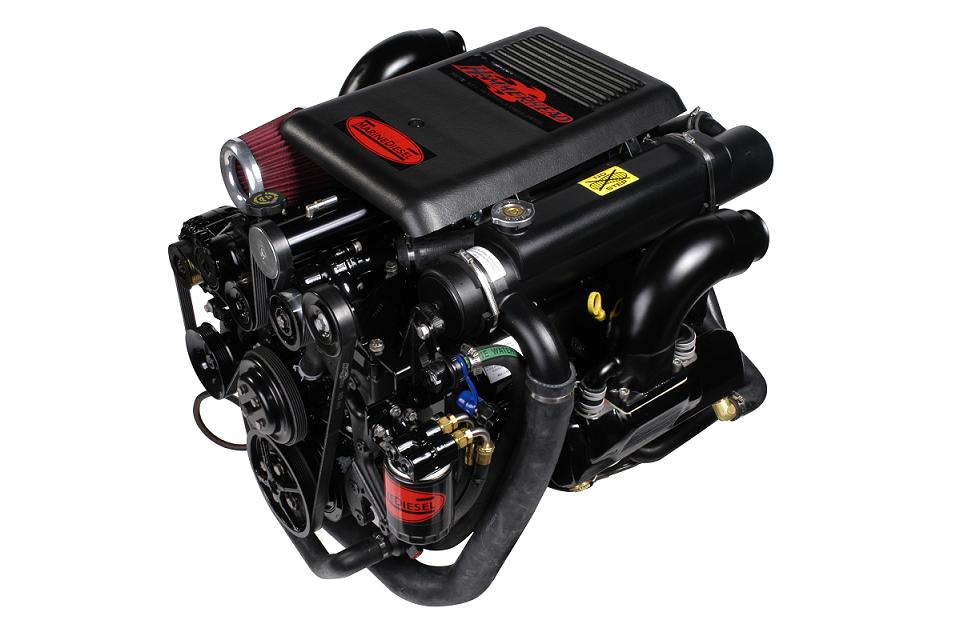
:: HOW TO SELECT THE RIGHT ENGINE::

Boat Store Online.com


Home

Email us

978-397-0725

When looking to re-power from an existing gas engine up to diesel it’s common to
wonder about the proper method of estimating the performance gains associated with
the MarineDiesel product. The following information serves as a guideline in assisting
customers develop a feel for what they can expect;
350 Cu In (250 Hp)
When estimating the performance gains with an MD250 versus the 350 Cu In gas
engines, the diesel will outperform this range of engine extremely well. This gasoline
engines produce torque in the range of 350 Lb-Ft and therefore the additional 125 Lb-
ft produced by the MD250 is more than adequate in compensating for the loss in rpm.
It is common to see significant gains on top speed and cruise speed as well as
extremely good low speed acceleration versus the gas engines. Customers can
expect to see fuel savings in the range of 30% - 50%.
454 Cu In (330 hp)
The main thing to consider when repowering from gas to diesel is that the torque
rating is what has to be compared rather than the horsepower. It is common for
customers to expect to replace a 250 Hp gas engine with a 250 Hp diesel. The fallacy in
this is that with the diesel engine you lose approximately 1,000 rpm versus the gas
engine, and therefore need additional torque to offset the difference in prop speed
with a larger prop. The rule of thumb is that for each pitch of prop is equivalent to 200
rpm., and therefore 5 additional prop pitches would be required to offset a 1,000 rpm
reduction. For example the MD300 compares out very well against the 330 Hp 454 due
to the fact that the MD300 produces approximately 100 Lb-Ft more torque than the 454.
It is this additional 100 Lb-Ft that allow the prop pitch to be increased as required to
make up for the loss in rpm. The larger prop then allows the boat to plane much better
as well as much improved cruising speeds. In some cases the gear ratio will even stay
the same while simply making the necessary adjustments through propping. Note -
When re-powering relatively heavy boats (10,000+ lbs) the increase in pitch will be
less than when re-powering lighter boats; typically in the range of 3 propeller pitches.
454/502 Cu In (385 & 415 Hp)
When estimating the performance gains with an MD300 versus the 454 mag or 502 mag
engines the main thing to consider is that both of these engines produce significant
torque and therefore expecting the same top speed is not realistic. These gasoline
engines produce torque in the range of 460 Lb-Ft and therefore the additional 50 Lb-ft
produced by the MD300 is not adequate to offset the 5 prop pitches required to
compensate for the 1,500 rpm, since these engines normally run between 4,800 and
5,000 rpm. Therefore it can be expected that 2 – 5 mph at top speed may be sacrificed.
However, the MD300 by utilizing a larger prop and making it’s peak torque at 1,600 rpm
versus 3,500 rpm with the gas engines will therefore yield much better low speed
acceleration, better cruise speeds and significant reductions in fuel consumption
ranging between 40%-60%.
wonder about the proper method of estimating the performance gains associated with
the MarineDiesel product. The following information serves as a guideline in assisting
customers develop a feel for what they can expect;
350 Cu In (250 Hp)
When estimating the performance gains with an MD250 versus the 350 Cu In gas
engines, the diesel will outperform this range of engine extremely well. This gasoline
engines produce torque in the range of 350 Lb-Ft and therefore the additional 125 Lb-
ft produced by the MD250 is more than adequate in compensating for the loss in rpm.
It is common to see significant gains on top speed and cruise speed as well as
extremely good low speed acceleration versus the gas engines. Customers can
expect to see fuel savings in the range of 30% - 50%.
454 Cu In (330 hp)
The main thing to consider when repowering from gas to diesel is that the torque
rating is what has to be compared rather than the horsepower. It is common for
customers to expect to replace a 250 Hp gas engine with a 250 Hp diesel. The fallacy in
this is that with the diesel engine you lose approximately 1,000 rpm versus the gas
engine, and therefore need additional torque to offset the difference in prop speed
with a larger prop. The rule of thumb is that for each pitch of prop is equivalent to 200
rpm., and therefore 5 additional prop pitches would be required to offset a 1,000 rpm
reduction. For example the MD300 compares out very well against the 330 Hp 454 due
to the fact that the MD300 produces approximately 100 Lb-Ft more torque than the 454.
It is this additional 100 Lb-Ft that allow the prop pitch to be increased as required to
make up for the loss in rpm. The larger prop then allows the boat to plane much better
as well as much improved cruising speeds. In some cases the gear ratio will even stay
the same while simply making the necessary adjustments through propping. Note -
When re-powering relatively heavy boats (10,000+ lbs) the increase in pitch will be
less than when re-powering lighter boats; typically in the range of 3 propeller pitches.
454/502 Cu In (385 & 415 Hp)
When estimating the performance gains with an MD300 versus the 454 mag or 502 mag
engines the main thing to consider is that both of these engines produce significant
torque and therefore expecting the same top speed is not realistic. These gasoline
engines produce torque in the range of 460 Lb-Ft and therefore the additional 50 Lb-ft
produced by the MD300 is not adequate to offset the 5 prop pitches required to
compensate for the 1,500 rpm, since these engines normally run between 4,800 and
5,000 rpm. Therefore it can be expected that 2 – 5 mph at top speed may be sacrificed.
However, the MD300 by utilizing a larger prop and making it’s peak torque at 1,600 rpm
versus 3,500 rpm with the gas engines will therefore yield much better low speed
acceleration, better cruise speeds and significant reductions in fuel consumption
ranging between 40%-60%.


Click images